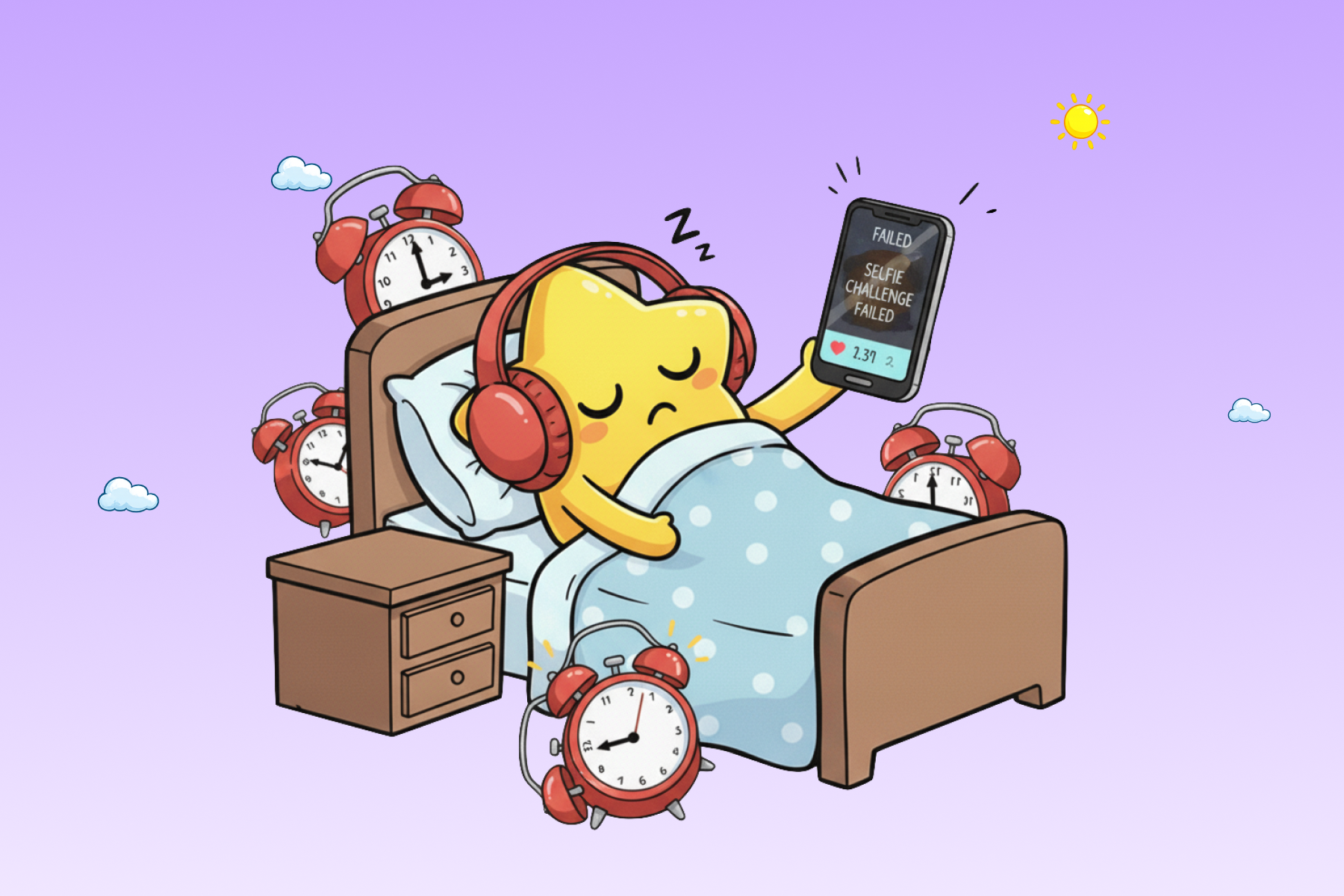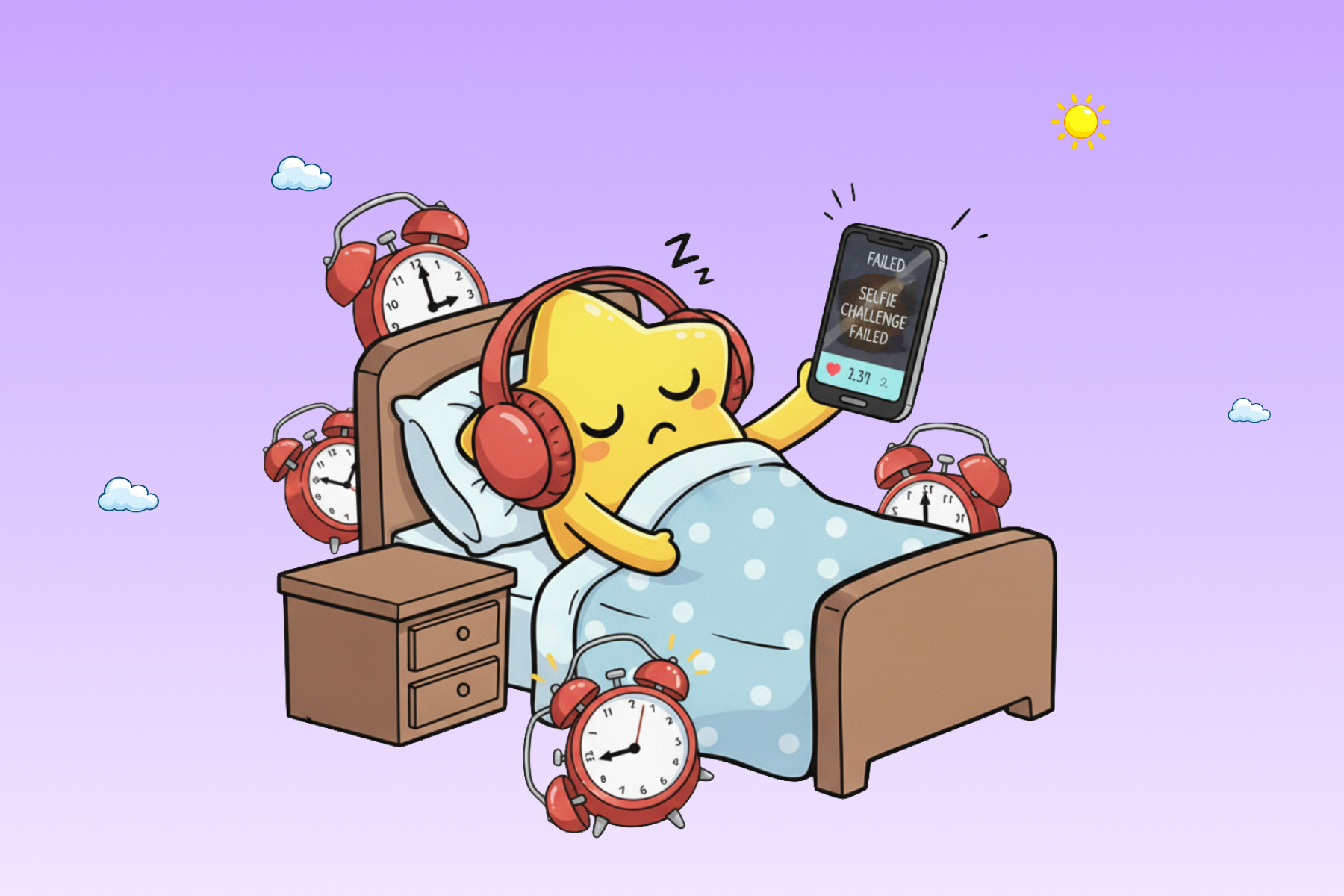
If you've ever slept through an alarm loud enough, close enough, set multiple times and still woken up late, you're not alone. The alarm isn't broken. The sound often does reach your brain. Your body just doesn't respond.
The assumption is that sleeping through an alarm means you weren't trying hard enough that you could have gotten up if you really wanted to. That framing feels intuitive. It also ignores how sleep actually works.
During deep sleep, the brain regions responsible for deciding to act on sound are largely offline. Hearing an alarm and being able to get out of bed are not the same process. This isn't laziness or poor discipline. It's a measurable neurological state called sleep inertia and here's what's going on when you can't wake up in the morning.
what sleep inertia actually is
Sleep inertia is the transitional state between sleep and full wakefulness. It's not a mood. It's not tiredness you can push through. It's a measurable neurological condition with a specific mechanism and it's why your alarm is failing you.
A 2025 study in Current Biology (Stephan et al.) mapped over 1,000 arousals from sleep and found that wakefulness doesn't arrive all at once. It spreads across the brain in a wave. The first regions to rouse are those associated with executive function and decision-making, at the front of the head. The wave then travels backward to sensory and visual processing regions. The whole process takes time and crucially, it can be interrupted.
Here's what this means for your alarm: sound arrives at your auditory cortex, which can be partially active even during deep sleep. That's why the alarm sometimes gets folded into a dream: your brain heard it. But the decision to respond to it, to reach out and turn it off, to get up that comes from the prefrontal cortex, the executive function region. Which is still offline.
You heard the alarm. The part of your brain that acts on it wasn't home yet.
A louder alarm doesn't solve this. It reaches the same circuits. The answer isn't volume. It's engagement.
why some people sleep through anything (it's genetic)
If you've always been a heavy sleeper if your family members are too, if you've slept through fire alarms and thunderstorms and phones going off next to your head, there's a specific reason for that.
Sleep spindles.
Sleep spindles are brief bursts of brain waves generated in the brain's thalamus while you are in non-REM sleep. They last about half a second to two seconds each. A healthy adult produces roughly 1,000 to 2,000 of them per night. Their job is to gate out external sensory information - to actively prevent sounds from waking you during deep sleep stages. They are, essentially, your brain's noise-cancelling system.
Individuals with higher spindle density show a greater resistance to external noise during sleep. This has been confirmed by EEG research across large populations, including a study of 11,630 individuals published in Nature Communications (Purcell et al., 2017) which found that genetic factors significantly contribute to spindle activity. Spindle density is one of the most heritable sleep traits. If you're a heavy sleeper, it's likely because you produce more sleep spindles and your brain is extremely good at blocking external noise.
This isn't a malfunction. It's what the system was designed to do. The problem is that the same mechanism that filters out traffic noise and a neighbour's TV also filters out your 6 AM alarm.
You are not lazy. Your thalamus is excellent at its job.
the chronotype factor
Even if you're not a heavy sleeper by nature, your alarm might be firing at the worst possible biological moment.
Night owls produce melatonin later in the evening than morning chronotypes. This is well-established in chronotype research - the Per3 gene, which influences circadian timing, has variants that consistently track with late vs. early preference. Evening types release melatonin an hour or two later, fall asleep later, and - critically - clear that melatonin later in the morning.
If you're a natural night owl being forced into a 6 AM or 7 AM schedule, your melatonin hasn't finished clearing when the alarm fires. Your brain is chemically mid-sleep. The clock says morning. Your neurochemistry says 3 AM. The alarm is not fighting your laziness. It's fighting your endocrinology.
This is closely related to social jet lag - the chronic mismatch between your biological sleep timing and your social schedule. If Monday mornings feel significantly harder than Saturday mornings, that gap is the measurement of how far your schedule is from your biology.
what makes it worse
Sleep inertia is a baseline condition for most people. Several things compound it significantly.
sleep debt is the most reliable amplifier. The more sleep you've deferred across the week, the deeper the sleep inertia when the alarm fires. A body running a 14-hour sleep deficit is not in the same waking state as a rested one. If you want to understand how much debt you're carrying, the lumi sleep debt calculator takes 90 seconds.
inconsistent wake times prevent your circadian rhythm from anchoring. Your body's internal clock produces a cortisol spike - called the cortisol awakening response - shortly before your usual wake time, priming alertness. If your wake time varies by two hours day to day, that anticipatory response never calibrates properly. Monday's alarm has no cortisol runway.
alcohol the night before: Many people wrongly use alcohol as a sleep aid. While a nightcap might help you fall asleep faster, a 2024 study in Sleep Medicine Reviews proves it destroys your sleep quality. Even just two drinks significantly cut down on your REM sleep—the stage your brain needs for memory and mood. Once the alcohol wears off in the second half of the night, your body startles awake repeatedly. You wake up to your morning alarm feeling exhausted, having spent the night in fragmented, low-quality sleep rather than truly resting.
room temperature disrupts sleep continuity at the extremes. A room that's too warm prevents the core body temperature drop that deepens sleep. A room that's too cold causes repeated micro-arousals. Either condition fragments the sleep architecture that determines how deep you are when the alarm fires.
late-night screen use delays melatonin onset by suppressing it with blue-wavelength light - sometimes by 60 to 90 minutes - which pushes the entire sleep schedule later. Doomscrolling and sleep covers the melatonin and REM mechanism in detail. The short version: the night before explains most of the morning.
what actually helps (and why louder isn't it)
Given everything above, the answer is not a louder alarm. The auditory cortex receives the signal, but the thalamus blocks it from reaching your executive function regions. Loud noises just cause a panicked snooze reflex; instead, melodic, rising tones are proven to penetrate this sensory gate and smoothly transition brainwaves toward alertness.
Sound alone, however, cannot bridge the activation gap reliably. Physical engagement can.
Moving your body: completing a task, walking to another room, taking a photograph, forces cortical activation that passive sound cannot produce. Research on wake-up challenges confirms that completing a behavioural task immediately upon waking accelerates the transition through sleep inertia. The task forces the executive function regions online, not by request, but by demand.
This is the difference between an alarm that asks and an alarm that requires
Light exposure within the first few minutes also helps bright light suppresses residual melatonin and begins resetting your circadian clock for the next night. Getting out of a darkened bedroom quickly, or having bright overhead light on immediately, accelerates the neurochemical shift.
Caffeine works, but with a 20-minute delay before it takes effect, it doesn't help the moment of waking, only the 20 minutes after. The alarm still has to get you out of bed first.
why lumi's wake-up challenges are designed the way they are
Lumi's morning challenges: face verification, walking steps, squats, pushups, math problems, emoji matching are not gimmicks. They're a specific response to the neuroscience of sleep inertia.
Physical exercises are the hardest challenges to complete while still in a sleep state. Squats, pushups, jumping jacks, and step walks demand sustained movement, your heart rate has to rise and your body has to stay active, not just upright. That level of engagement is difficult to fake from bed. Math can be done lying down with eyes half-shut. Face verification only needs you sitting up in front of the camera. Shake challenges can be completed horizontally. Movement-based tasks force the cortical activation that lighter challenges can't produce on their own.
The challenge rotates across your selected pool, never the same two mornings in a row which prevents the muscle memory that lets habitual snoozers dismiss a known challenge without full wakefulness.
And lumi locks your apps the night before, so the morning you wake into isn't already running on a sleep debt. The challenge alarm is the second half of a system. The first half is the night that preceded it.