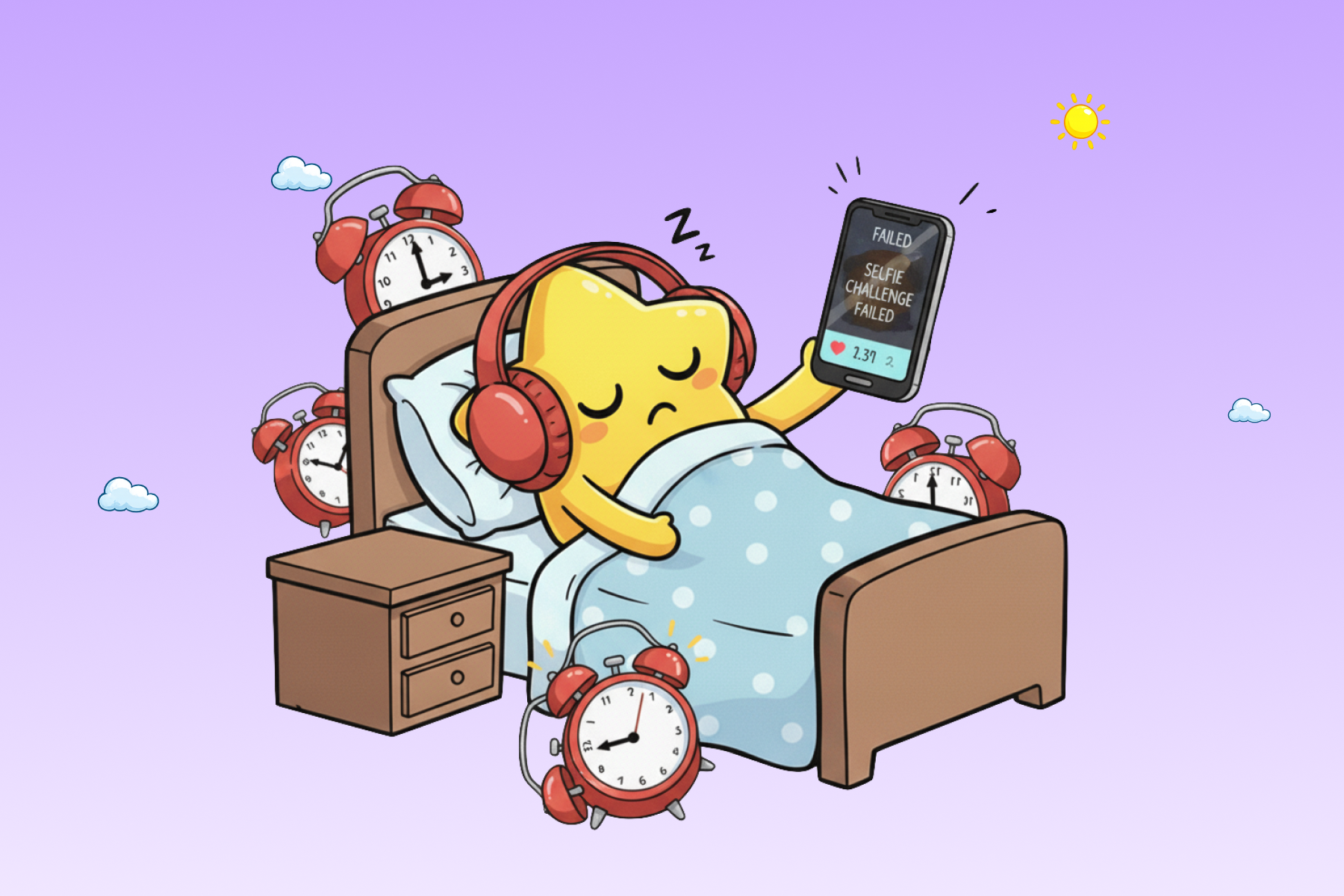
Somewhere between the alarm and the bathroom, you agreed to things you won't remember agreeing to.
You answered texts. Maybe sent an email. Had a conversation with someone in your house that vanished completely by the time you got to the kitchen.
All of it happened while you were, technically, still asleep.
Not sleep-asleep. But not awake either. Somewhere in the gap between your alarm firing and your brain actually arriving, you were already moving. Already responding. Already making decisions.
Just without the part of you that remembers making them.
That gap has a name. It's called sleep inertia and it's neuroscience. And once you understand what's actually happening in your brain during those foggy first minutes, mornings start to make a lot more sense.
what sleep inertia actually is
Sleep inertia is the transitional state between sleep and full wakefulness, characterised by reduced alertness and impaired cognitive and behavioural performance immediately upon waking. The CDC (Centers for Disease Control and Prevention) puts its typical duration at 15 to 30 minutes but notes it can last up to two hours depending on severity. Researchers studying on-call emergency personnel take it seriously enough to list it as a safety risk, the period where someone might be driving, giving medical advice, or operating equipment while not yet cognitively functional.
The name comes from physics. An object in motion stays in motion; an object at rest stays at rest. A brain in sleep stays in sleep, even when the alarm has told it to be awake.
What's happening at the neural level is specific. Brain imaging studies show that cerebral blood flow is lower than pre-sleep levels for up to half an hour after waking. The reactivation isn't uniform. Areas involved in basic arousal: the brainstem, basal ganglia, and thalamus come back rapidly. The prefrontal cortex, which governs executive function, decision-making, and working memory, takes significantly longer to return to baseline.
This is why you can perform simple automatic tasks: turning off the alarm, making coffee, responding to a text - while still being unable to do anything that requires judgment. The lights are on. The occupant is not home yet.
When you wake up, your brain doesn't come back all at once. A 2025 study tracking over a thousand awakenings found that it powers up in stages, sensory awareness first, then spatial orientation, with memory and decision-making coming online last. That's why you can hear your alarm, turn it off, and still have no memory of doing it minutes later.
The type of sleep you're waking from matters too. Waking out of deep sleep comes with a brief surge of slow brain activity just before you open your eyes and oddly, that surge actually predicts a sharper, quicker waking. Waking from REM sleep skips that surge entirely, which is part of why a REM interruption can leave you feeling more disoriented, even though REM is technically the lighter stage.
The simpler version: your brain doesn't wake up all at once. The part you actually need comes last.
why it's worse on some mornings
the sleep stage you were interrupted from
Sleep cycles through stages roughly every 90 minutes: light sleep, deep sleep, and REM. The stage you wake from makes a significant difference. Waking from deep sleep produces the most severe sleep inertia by far; studies show it impairs performance noticeably more than waking from lighter stages or REM. It's the reason a 20-minute nap can leave you feeling worse than before you closed your eyes, if you sleep long enough to tip into deep sleep and get pulled out mid-cycle, you'll wake up more confused, not less tired.
Slow-wave sleep is concentrated in the first half of the night. By early morning, sleep cycles shift toward more REM. This means: if your alarm fires on schedule after a full night, you're more likely to wake from lighter sleep. If you went to bed two hours late and your alarm is the same, the alarm is now catching you in heavier, earlier-cycle sleep. Same alarm time, much worse morning.
sleep debt
Sleep inertia is worsened by sleep deprivation. A brain carrying accumulated sleep debt hasn't finished what it needed to do during the night. Waking it before completion produces more of the grogginess, more impaired cognition, and a longer recovery window. This compounds: chronic sleep restriction makes every morning harder, not just the ones after a single late night.
irregular schedule
A consistent wake time helps because your circadian system uses it as a cue. When your wake time varies by two or three hours across the week: as it does for most people on a weekday-weekend split: the body's preparatory mechanisms (the cortisol awakening response, core temperature rise) are timed to the average, not the specific morning. The result is more frequent cycle mismatches and worse inertia.
alcohol, medication, and sleep disorders
Alcohol suppresses REM sleep in the first half of the night and causes a rebound of lighter, more fragmented sleep later on. Waking after a night of drinking often means waking from disrupted late-night sleep at an unfavorable cycle point. Sedating medications and untreated conditions like sleep apnea compound the same basic problem: poor-quality sleep producing harder mornings.
what actually reduces it
physical movement (most effective, fastest-acting)
Getting vertical and moving is the fastest behavioural intervention for sleep inertia. The mechanism is direct: physical activity increases cerebral blood flow, stimulates the cortisol awakening response, and raises core body temperature - the three physiological changes that define the waking process. You're not fighting the biology; you're accelerating it.
Both high-intensity and light-intensity exercise have been shown to help, with higher intensity producing stronger effects. The duration required is short - even five to ten minutes of movement produces measurable improvement. The research is robust enough that sleep inertia management has been formally proposed as a safety protocol for on-call emergency personnel, with exercise as the primary countermeasure.
You don't need to run a mile at 6 AM. You need to be vertical and physically active for a few minutes.
light exposure
Bright light - even through a window on a cloudy day - rapidly accelerates the transition out of sleep inertia by suppressing residual melatonin and advancing the cortisol curve. It's most effective when combined with movement. Getting outside, or standing near a window, in the first few minutes after waking addresses both simultaneously.
caffeine (with a caveat)
Coffee feels like the obvious fix, but the timing matters more than most people realise.
Caffeine works by blocking the brain chemical that makes you feel drowsy but it takes 20 to 45 minutes after you drink it to actually kick in. Reaching for coffee the moment your alarm goes off means you're still unprotected through the worst of sleep inertia, then hit with the caffeine effect after you've already muddled through.
There's also a natural alerting process your body runs on its own in the first thirty minutes of waking, a cortisol rise that helps pull you toward full consciousness. Immediate caffeine can blunt that process before it does its job.
The better approach: wait 20 to 30 minutes after waking before your first cup. You work with your body's own system instead of cutting it off, and the caffeine arrives just when it's actually useful.
cold water
Splashing cold water on your face or brief cold exposure: activates the sympathetic nervous system and increases alertness rapidly. It's not a sustained fix, but as an immediate intervention it helps. The mechanism is reflex arc, not circadian: it startles the nervous system into higher arousal.
what makes it worse
snoozing
The research on snoozing is more nuanced than most articles admit. The Ogawa et al. (2022) laboratory study found that snooze alarms prolonged sleep inertia compared to a single alarm, due to repeated forced awakenings creating fragmented lighter (N1) sleep. A larger study by Sundelin et al. (2023) found that 30 minutes of snoozing slightly improved cognition on waking for habitual snoozers compared to a single alarm though without improving subjective sleepiness or mood.
The honest interpretation: the snooze evidence is genuinely mixed for short-term cognitive performance. What's not mixed is that snoozing doesn't improve sleep quality or sleep quantity, and for most people it extends the time spent in the ambiguous state between sleep and wake without resolving it. If you snooze because you're drowsy, you will still be drowsy when you get up, just more confused about time.
staying horizontal
Remaining in bed after the alarm fires, even without sleeping, extends sleep inertia. The transition to wakefulness is partly driven by postural change, getting vertical shifts blood pressure regulation and increases arousal. People who lie in bed scrolling their phone in the first ten minutes after waking are spending that time in the exact state they're trying to exit.
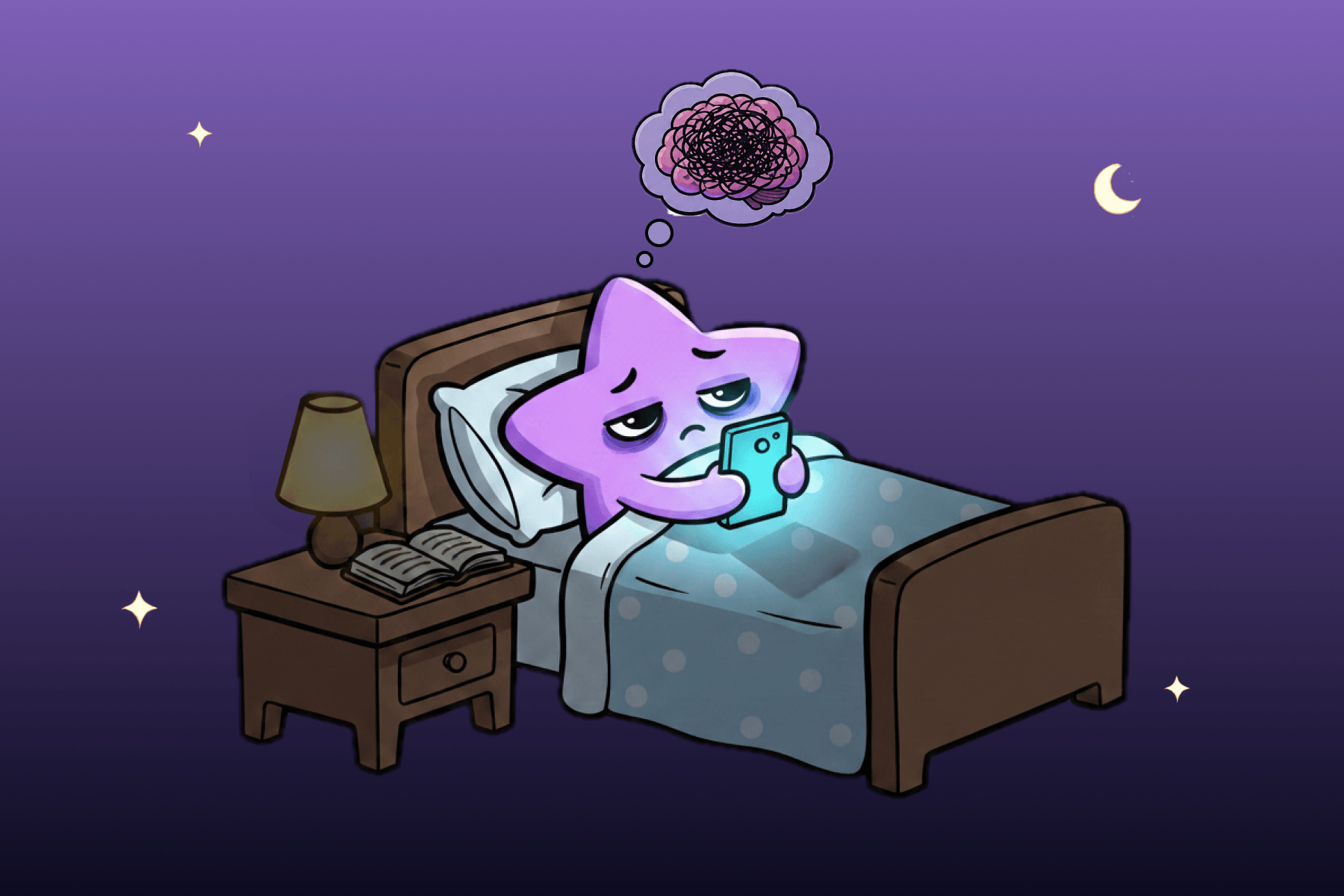
checking your phone in bed
This one has a double cost. It extends the passive, horizontal state that slows inertia dissipation, and it front-loads high-dopamine input before the prefrontal cortex is fully operational meaning you're spending your first neurochemical resources on the least valuable input, while still cognitively impaired. It neither resolves the inertia nor produces the benefits you'd need to justify the trade-off.
where sleep drunkenness fits in
"Sleep drunkenness" clinically called confusional arousal is a more extreme version of sleep inertia where the person wakes disoriented, sometimes speaking incoherently, acting without memory of it afterward, or behaving in ways they later don't recall. It's more common in people with highly irregular sleep schedules, excessive sleep duration, or underlying sleep disorders.
The behaviour I described at the start: answering messages without awareness sits somewhere between ordinary sleep inertia and confusional arousal. It's more common than most people admit, and it's one of the reasons that the decisions and communications made in the first 15 minutes after waking are reliably worse than those made once the prefrontal cortex has finished coming back online.
the lumi connection
The physical challenge that turns lumi's alarm off is the fastest known behavioural intervention for sleep inertia applied at the moment of waking.
When lumi requires you to walk thirty steps, hold a plank, do jumping jacks, or smile for the camera before the alarm stops: you are doing exactly what the sleep science prescribes: getting vertical, initiating physical activity, increasing blood flow, and forcing motor-and-cognitive engagement before you're allowed to return to any horizontal passive state.
It isn't punishment. It's countermeasure. The challenge accelerates the biological process of waking up at the precise moment it needs acceleration most.
If the night before is why the mornings are hard, late-night scrolling, disrupted sleep, insufficient REM - doomscrolling and sleep: what it actually does to your brain connects the night-side cause to the morning-side effect.
Wake up like your brain is working. Try lumi free for 7 days →