what social jet lag actually is
Chronobiologists define social jet lag as the mismatch between your circadian clock's preferred sleep timing and the sleep timing your social schedule imposes on it. It's measured as the difference in midsleep time between free days, typically weekends and work or school days.
The jet lag framing isn't metaphorical. It's biologically accurate. When you stay up until 1 AM on Friday and Saturday and sleep until 10, then have to wake at 6:30 on Monday, your body experiences a phase shift comparable to flying west on the weekend and east on Monday. The disorientation is real. The symptoms difficulty sleeping Sunday night, heavy grogginess Monday morning, a dragging first half of the week are what circadian misalignment looks like from the inside.
A large epidemiological study published in Current Biology found that social jet lag, independent of total sleep duration, was associated with higher BMI, greater daytime sleepiness, and increased depressive symptom scores. The mismatch itself carries costs beyond just lost sleep hours. It isn't just about the quantity of sleep. It's about when that sleep happens relative to what your biology was expecting. If your weekdays are also short on hours, run the sleep debt calculator so you're not only fixing midsleep while a weekly deficit keeps dragging you down.
who is most affected and why it's not a character flaw
Night owls carry a disproportionate share of social jet lag, and this is worth understanding clearly: chronotype - your natural tendency toward earlier or later sleep timing - is substantially determined by genetics and age, not habits or discipline. Late chronotypes have circadian clocks that push melatonin onset and sleep pressure later. Their biology is running a different schedule than the standard 9-to-5 world assumes.
For late chronotypes, the weekend is often the only time they sleep in alignment with their actual biology. Which is why the swing is larger - they're not being lazy, they're catching up to where their circadian system was all along. The fix isn't to pretend to be a morning person. The fix is to close the gap between free-day and workday sleep timing as much as your actual life allows, so the weekly phase shift shrinks.
how social jet lag compounds sleep debt
The two problems interact. Research on sleep debt and social jet lag in working populations found that the combination is worse than either problem separately large weekly midsleep shifts alongside a chronic sleep deficit produce greater daytime impairment, worse mood outcomes, and more difficulty concentrating than either condition in isolation. Doomscrolling and sleep: what late-night scrolling does to your brain ties the “why do I feel hungover on Tuesday” feeling back to REM and melatonin when late feeds widen that midsleep gap.
This is why the calculator shows both: the midsleep gap that represents your social jet lag, and the directional shift that closing it would require. If your gap is two hours, eliminating it in one weekend isn't biologically possible, your circadian system shifts its timing by roughly 30 to 45 minutes per day under normal conditions. Trying to jump two hours in one night doesn't fix the schedule. It produces a night of lying awake at an earlier-than-your-body-expects time, oversleeping anyway, and concluding your schedule is unfixable.
It isn't unfixable. It just requires a different approach.
how to actually fix a sleep schedule, what the research supports
Anchor the wake time first, not the bedtime. Morning light is the primary circadian cue. Your body uses it to set the clock, the entire downstream cascade of melatonin onset, body temperature, cortisol, and hunger follows from the morning anchor. Fix the wake time seven days a week, keep it consistent within 30 minutes, and the rest of the schedule tends to follow. Trying to fix bedtime first without anchoring wake time is working backwards.
Close the weekend gap in small increments. If your free-day midsleep is two hours later than your workday midsleep, shift your weekend bedtime and wake time earlier by 20 to 30 minutes per week. You can still sleep in. Just less dramatically each week. The gap closes, the Monday morning phase shift shrinks, and the transition stops feeling like jet lag because it effectively stops being jet lag. Once your wake anchor is stable, the ideal bedtime calculator can translate it into cycle-aligned bedtimes so you're not guessing from midsleep alone.
Use morning light deliberately. Outdoor light in the first hour after waking accelerates circadian entrainment faster than any supplement. Even ten minutes outside, not through a window tells your pacemaker what time it is with more precision than most people realise. On the days you need to shift your clock earlier, this is the most reliable tool available.
Stop the thing that's widening the gap in the first place. The reason social jet lag is so persistent for most people isn't that they don't know they should go to bed earlier on weekends. It's that the apps they're using Friday and Saturday nights are specifically designed to push bedtimes later, and they work. Feed engagement peaks late because platforms know that's when attention is most available and inhibition is lowest. Every Friday night of scrolling until 2 AM is adding to the midsleep gap the calculator just showed you - the same structural story the app that locks TikTok at bedtime (and makes you do squats to wake up) tells for locks you configure before the feed has its hooks in you.
why the same bedtime on weekends is harder than it sounds and what to do about it
The calendar says you can sleep in. The phone says you should stay up. And at 11:30 PM on Friday, when your prefrontal cortex has been running for 16 hours and the feed is showing you exactly what it knows will keep you engaged, you are the least equipped version of yourself to win that negotiation.
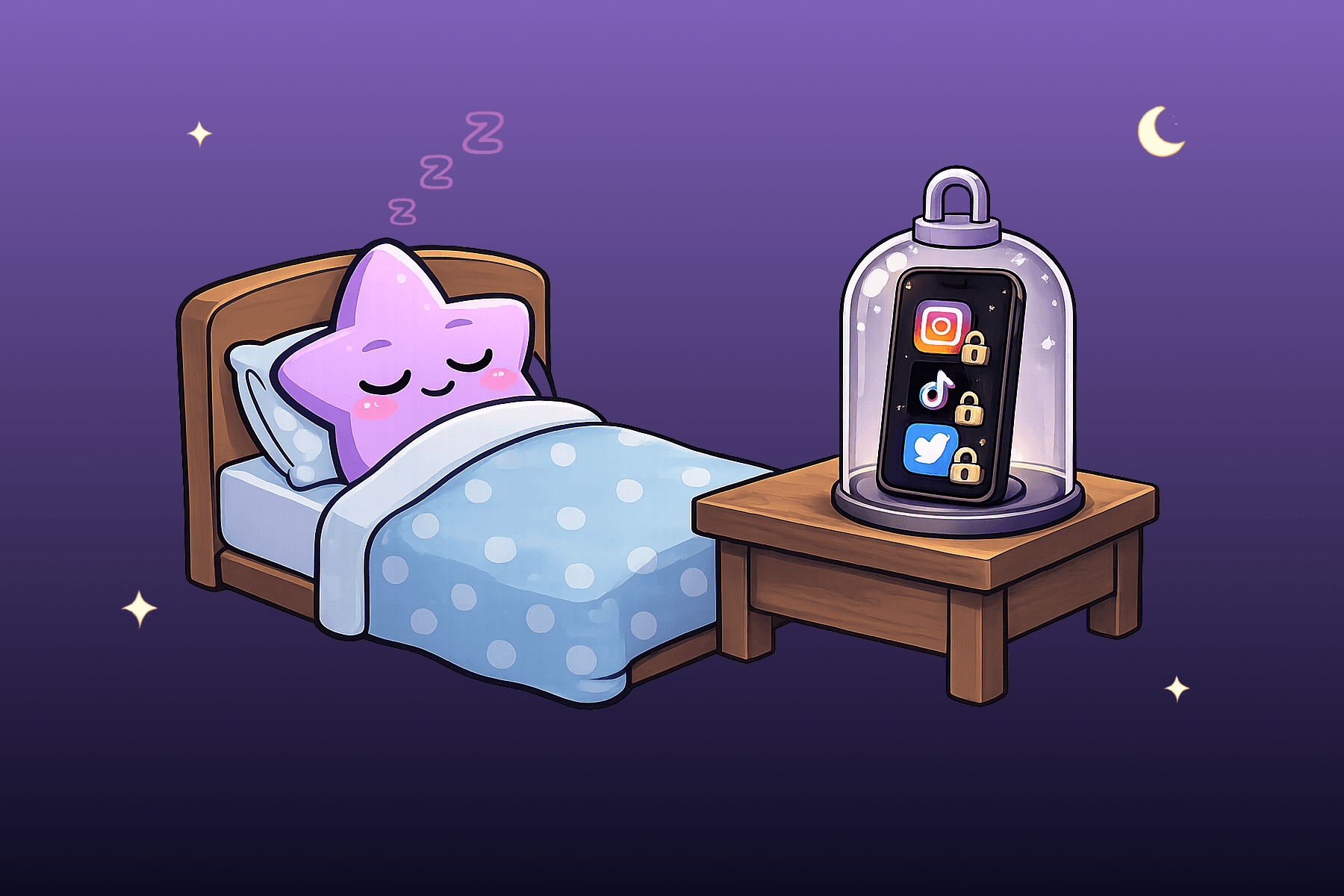
lumi's bedtime lock lets you set a consistent weekend bedtime lock when you're thinking clearly not at the moment the negotiation happens. At the lock time, the apps that would otherwise run your bedtime an hour or two later become unavailable. The decision was already made. Friday-night-you just lives with it.
That's how the gap actually closes not through better intentions on Saturday night, but through structure that doesn't rely on intention at all. For a wind-down you can repeat after the lock fires, how to build a bedtime routine you'll actually stick to keeps activation energy low.