You've heard "phones disrupt sleep." You've nodded, put your phone down, and picked it back up four minutes later.
Knowing something in the abstract doesn't change behaviour. Knowing the mechanism - the specific biology of exactly what is happening, in your body, right now, while you scroll - sometimes does.
Here are 10 sleep science facts about phones and sleep:
1. Your Melatonin Has a 90-Minute Delay You Can't Override
You don't feel sleepy when you expect to. You feel sleepy roughly 90 minutes after you expected to. Here's why.
The mechanism: Melatonin production is suppressed by light - specifically blue-wavelength light, which is the primary output of phone screens. Research by Gooley et al. (Harvard Medical School / Brigham and Women's Hospital) found that room light exposure before bedtime suppressed melatonin in 99% of participants and shortened the body's melatonin production window by roughly 90 minutes. The suppression kicks in quickly and doesn't require unusually bright light - ordinary room light at less than 200 lux is enough.
The implication: When you scroll until midnight, your body doesn't begin its transition into sleep mode until well after you put the phone down. You're not an insomniac. You're running a biological delay you triggered yourself.
2. Blue Light Is the Specific Wavelength Your Brain Uses as a "Morning" Signal
Your phone's backlight is engineered for visibility. That engineering happens to be the exact signal your brain uses to suppress sleep.
The mechanism: Your circadian system's primary light-sensitive photoreceptors - intrinsically photosensitive retinal ganglion cells (ipRGCs) - are maximally sensitive to light at around 480 nanometres. That's blue light. It's the wavelength most concentrated in midday sunlight, which your brain uses to calibrate wakefulness and anchor your circadian clock. Phone displays optimise their backlights for colour accuracy and visibility - and that optimisation concentrates blue wavelengths.
The implication: Every evening phone session is physiologically equivalent to a "morning" signal sent directly to your circadian system. Night mode and warmer display settings reduce but do not eliminate this effect. The more reliable intervention is stopping the exposure, not filtering it.
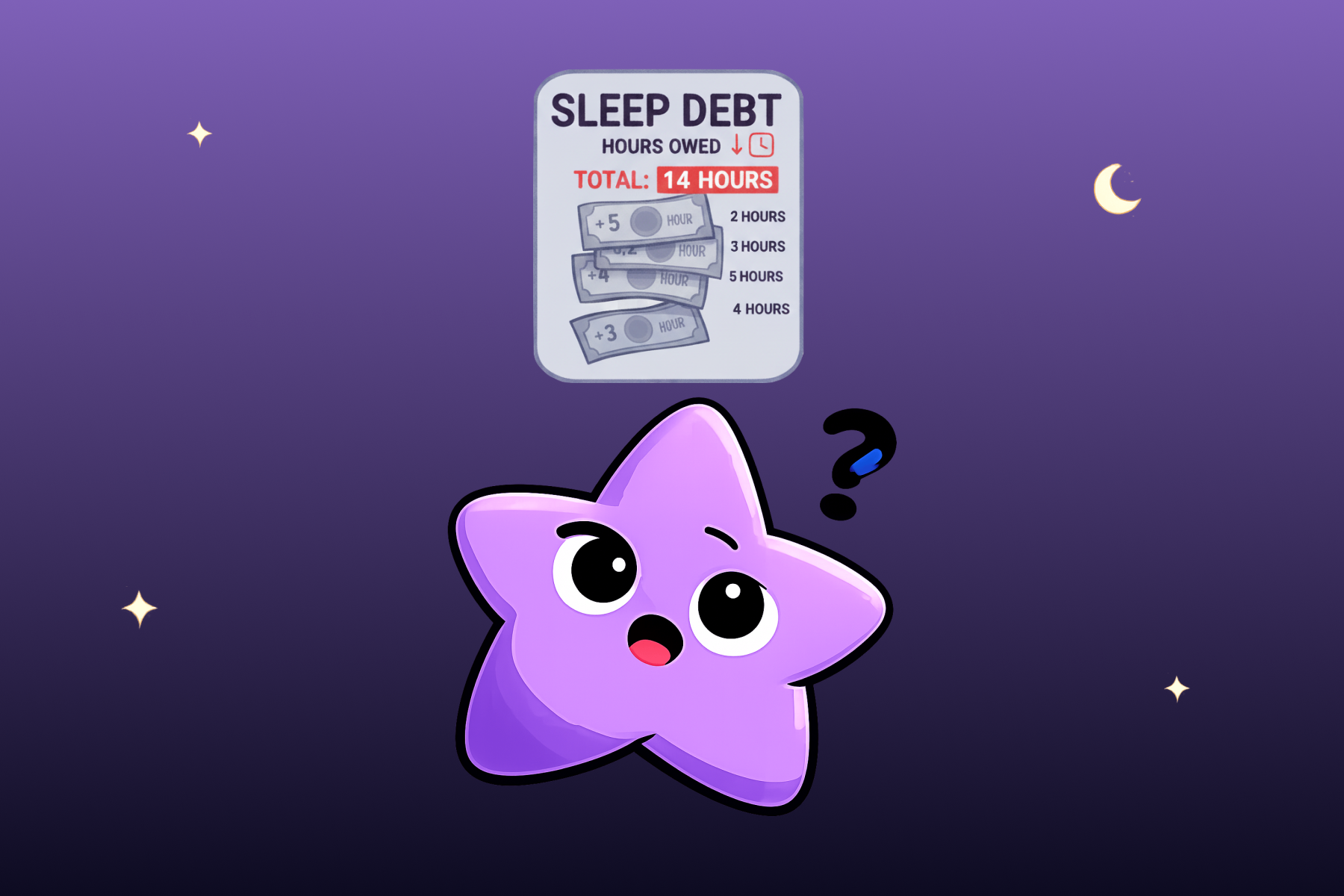
3. Two Hours of Scrolling Costs You More Than Two Hours
You didn't just lose the 2 hours. You lost the sleep those 2 hours were supposed to produce.
The mechanism: Sleep architecture follows cycles of approximately 90 minutes, cycling progressively through NREM stages toward REM sleep. REM - the phase critical for memory consolidation, emotional regulation, and cognitive processing - is heavily concentrated in the later cycles of the night. When you delay sleep onset by 2 hours and your alarm fires at the same time, those later, REM-heavy cycles are the ones you lose.
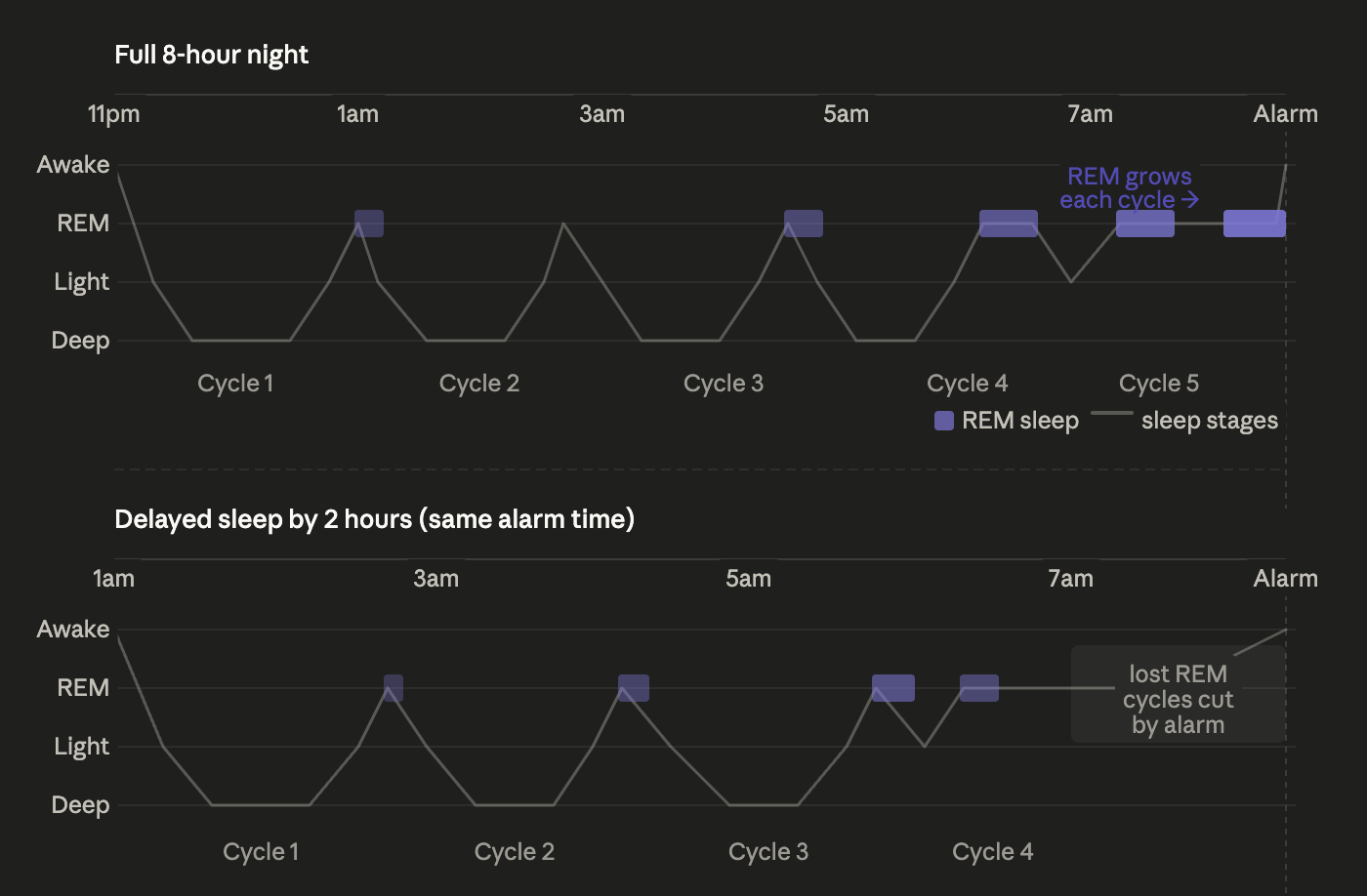
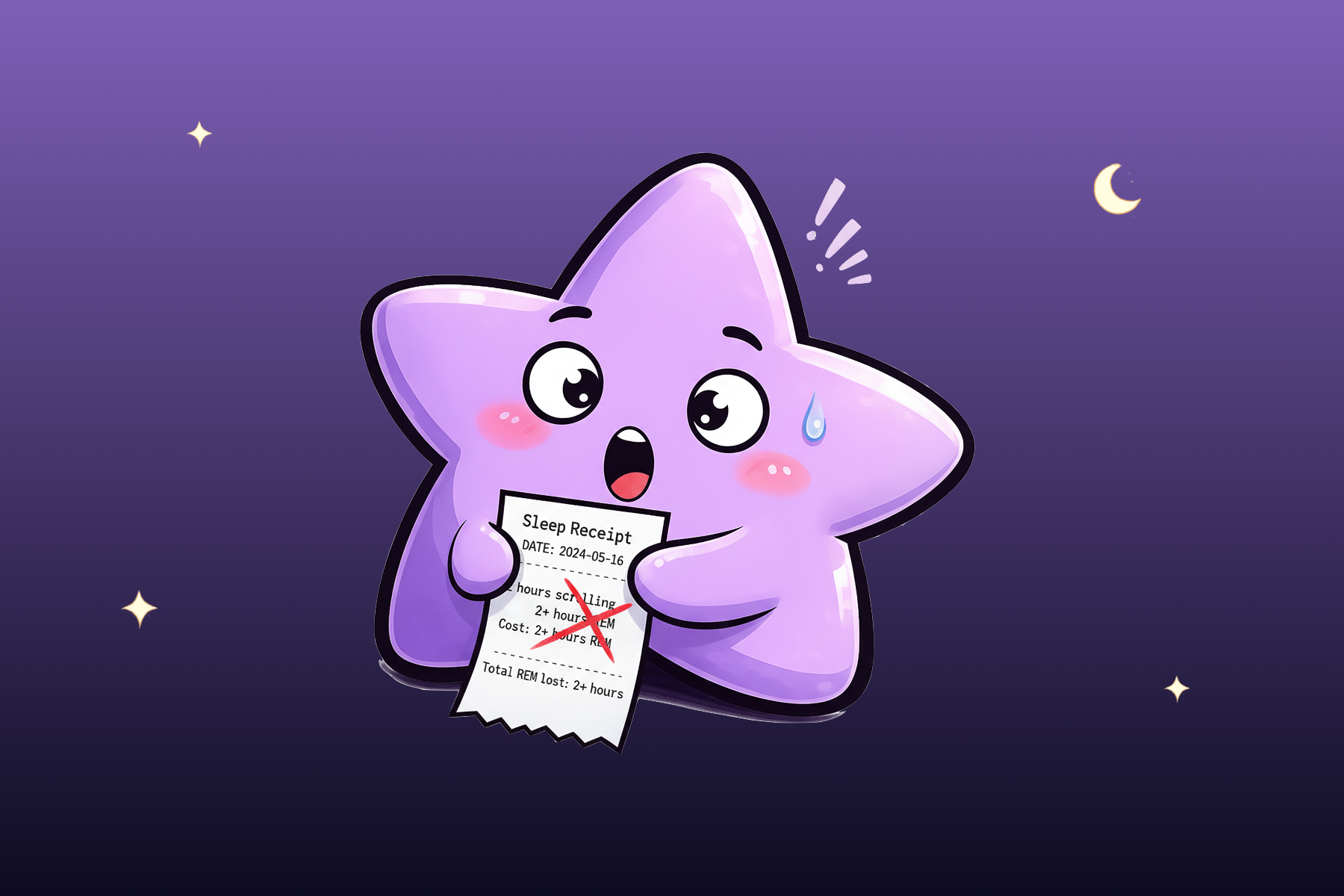
The implication: 2 hours of late-night scrolling costs you roughly 2 hours of sleep, but the sleep lost is disproportionately REM. The cognitive and emotional costs of REM loss are larger than the lost hours suggest. You're not just tired. You're running low on the most restorative part of sleep.
4. Your Stress Response Is Active While You Scroll
Doomscrolling is not relaxation. It is low-grade stress delivered continuously for however long your session runs.
The mechanism: Negative, high-arousal content - news, conflict, social comparison, anxious speculation - triggers cortisol release. Cortisol is your primary stress hormone and a direct chemical antagonist to melatonin. Extended exposure to a feed of such content keeps cortisol elevated for the duration of the session and for some time after. You cannot be in a cortisol-elevated state and simultaneously in the melatonin-rising state that sleep onset requires.
The implication: You are not decompressing while you scroll. You are accumulating a stream of cortisol triggers that chemically postpone sleep onset. The feeling of relaxation while scrolling is the dopaminergic reward cycle, not the physiological recovery state. They are not the same thing.
5. Social Media Is Engineered to Prevent You From Stopping
The reason you can't put it down has less to do with you than with the billions spent making sure you can't.
The mechanism: Variable reward schedules - the same mechanism behind slot machines - are the structural basis of social media feeds. Unpredictable, intermittent rewards (a surprising video, a post from someone you care about, a satisfying comment thread) produce dopaminergic responses that are more compulsive than predictable rewards. Your brain doesn't habituate to uncertain rewards. It escalates pursuit of them.
The implication: The scroll doesn't feel compulsive because you lack willpower. It feels compulsive because the product is engineered to produce exactly that sensation. Understanding this is useful - it shifts the frame from personal failure to structural problem, and structural problems require structural solutions.
6. Phones in the Bedroom Disrupt Sleep Even When You're Not Using Them
You don't need to be on your phone. Having it on your nightstand is enough to affect your sleep.
The mechanism: Research published in JAMA Pediatrics found that the mere presence of mobile devices in the sleep environment - including when turned off - was associated with significantly worse sleep outcomes. The likely mechanism: anticipation of notifications and habitual checking behaviour create low-level cognitive arousal that doesn't fully switch off. Your brain remains partially alert to the possibility of the phone.
The implication: Putting your phone face-down before bed is not sufficient. The phone's presence in the room maintains a degree of cognitive alertness that persists into sleep. The most effective intervention is physical displacement - the phone in another room. This is structurally inconvenient, which is why it works.
7. Sleep Deprivation Makes You Crave Exactly the Content That Keeps You Awake
The worse you sleep, the more you scroll. The more you scroll, the worse you sleep. This is not coincidence.
The mechanism: Sleep deprivation reduces activity in the prefrontal cortex - the region governing impulse control, long-term thinking, and cost-benefit evaluation. It simultaneously increases amygdala reactivity - your brain's emotional and reward-seeking centre. Tired brains are physiologically biased toward immediate, stimulating reward and away from anything requiring patience or delayed gratification. A social media feed is designed to exploit exactly this profile.
The implication: The compulsion to scroll is most powerful precisely when you're most depleted. The algorithm is optimised for your lowest-resistance state. This is a system producing a predictable outcome, not a reflection of your character.
8. One Shortened Night Has Cognitive Effects Equivalent to Mild Intoxication
Being awake for 17–19 continuous hours produces measurable impairment comparable to a blood alcohol level at or above the legal driving limit.
The mechanism: Williamson & Feyer (2000), published in Occupational and Environmental Medicine, found that 17–19 hours of continuous wakefulness produced cognitive and motor performance impairment equivalent to a blood alcohol concentration of 0.05% - the legal driving limit in most western European countries. At 24 hours of wakefulness, impairment reached the equivalent of a BAC of 0.10%. If you stay up until 1 AM and wake at 7 AM, you went to bed after 17+ hours of wakefulness. The math is straightforward.
The implication: You don't feel impaired in the morning because you slept. But the quality of that sleep - shortened, REM-depleted, melatonin-delayed - is not the same as adequate sleep. Subjective sense of alertness is not the same as actual cognitive function. That gap is also a feature of alcohol intoxication.
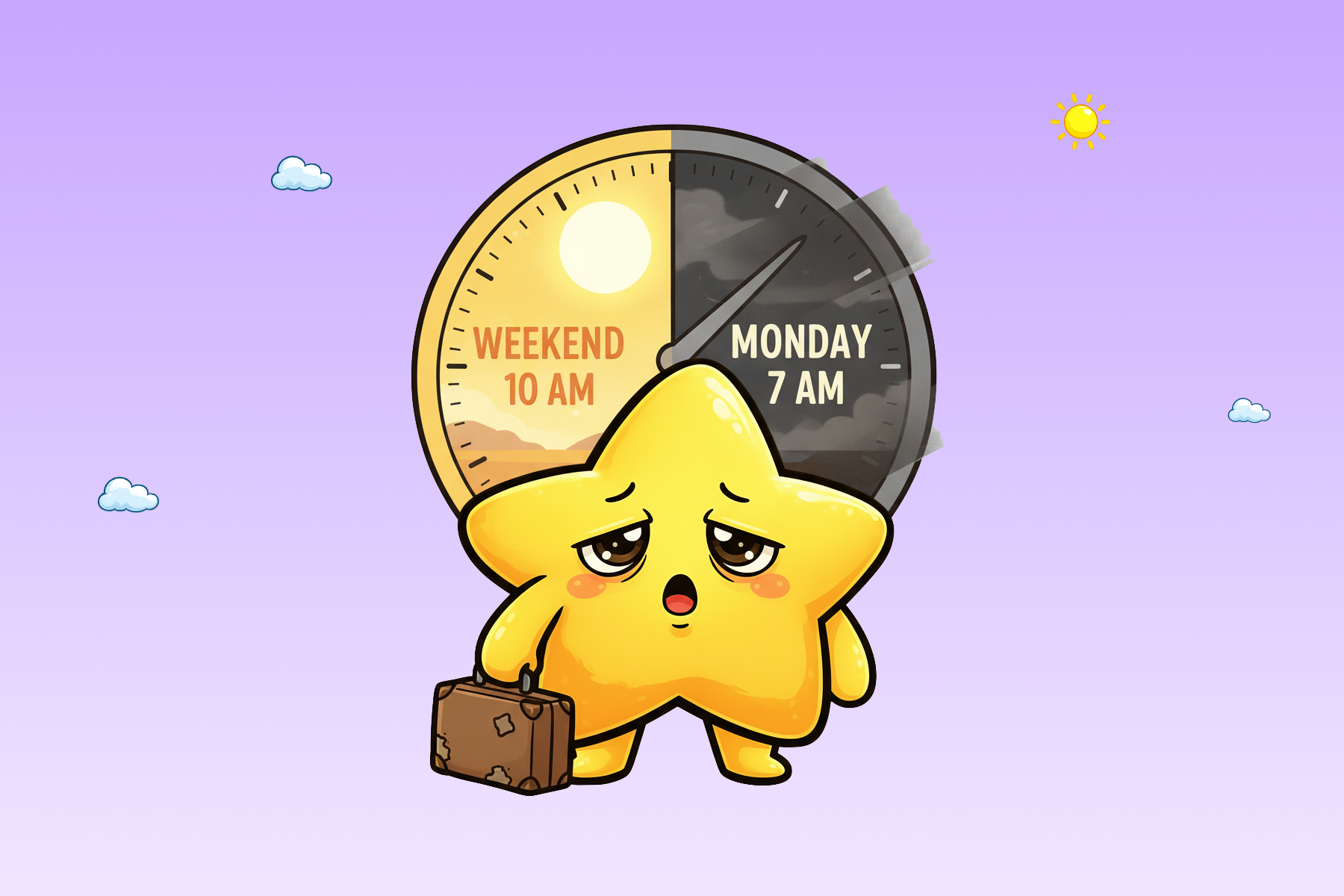
9. Weekend Lie-Ins Don't Repay Sleep Debt - They Reschedule It
Saturday sleep-ins feel restorative. The metabolic data disagrees.
The mechanism: A study by Depner et al. (Current Biology, 2019) tested whether ad libitum weekend recovery sleep could reverse the metabolic damage from a week of restricted sleep. It couldn't. Participants in the weekend recovery group gained weight, experienced reduced insulin sensitivity, and showed increased late-night energy intake - and these effects persisted after the recovery weekend and into the next workweek. The circadian phase delay caused by late weekends also compounded rather than resolved the problem.
The implication: Weekend sleep debt recovery is not a reliable strategy. The metabolic disruption accumulates regardless. The only effective approach is consistent, sufficient sleep across all seven days - which means consistent bedtimes, including weekends.
10. Putting Your Phone Down at Midnight Doesn't Mean Your Melatonin Starts at Midnight
The protective window isn't when you stop scrolling. It's when you started.
The mechanism: The melatonin suppression caused by evening light exposure doesn't resolve the moment you put the phone down. The Gooley 2011 study found melatonin duration was shortened by approximately 90 minutes following evening light exposure - and the suppression lingers past the point of exposure ends. The body needs time to clear the light signal and allow melatonin onset to begin. If you scroll from 9 PM to midnight and then go to bed, your melatonin onset may not begin until 1:30 AM or later.
The implication: The fix has to start earlier than the point where you feel tired. A bedtime lock that activates at 10:30 PM protects the melatonin window starting at 10:30 PM. One that activates at midnight doesn't - the suppression has already been running for hours.
This is the window lumi protects. When your apps lock before the suppression window opens, your melatonin process can begin on time. By midnight, you're already in sleep mode rather than still waiting for it.
The Pattern in All 10 Facts
Every fact on this list points to the same structural conclusion: the biology doesn't negotiate with your intentions. You can want to sleep and still not sleep if the chemical and neurological conditions aren't right. Those conditions depend on what your environment - and specifically your phone - is doing in the hours before bed.
Knowing these facts doesn't help unless something changes in the environment that produces them. A bedtime lock that activates before the suppression window opens is the structural change these facts are pointing toward.
lumi locks your apps when the damage starts - not after. Try it free for 7 days.